Friday, 10 December 2010

From Chef to Meteorologist

Another day off, and not wanting to waste my free time i was up early and after a quick cup of tea i was soon geared up, sunblock on and it was over to the Simpson building where most of the science takes place to meet Andy the Meteorologist, where i had arranged to shadow him for an hour just to find out a little more about our weather.  Since i have been at Halley the main work and topic of conversation has been the new build of Halley VI, what with all the Morrisons construction team and everything revolving around keeping them working, it has been all to easy to overlook the Halley Science, which is always at the forefront of why we are down here.
So today i aided Andy in launching the Weather Balloon, which helps monitor wind speeds, pressure and temperature, all valuable assets in forecasting the world wide weather.

The First thing Andy showed me was the Transmitter that is attached to the Balloon. This has a GPS antenna obviously for recording position, a temperature gauge and a power pack that he had on charge as i arrived. The cord you see on the table attaches to the balloon like a kite string. The battery is soaked to swell the cells and is then attached to the transmitter. the whole thing is in a white plastic casing lined with polystyrene to keep it light and warm. The battery does not freeze as it generates enough heat to prevent this.
   
The Command Centre of the Meteorologists, where all the data is collated

 These are the Balloons, and one is used daily at the same time every morning 8.00am.
 Andy told me that there is a balloon being released more or less simultaneously at various locations around the world. All this data gets put into a model which gives us the world wide weather. The more information the more acurate the weather forcasting.
 
 The balloon is packaged in a plastic bag and warmed to a certain temperature. This helps it expand as it rises
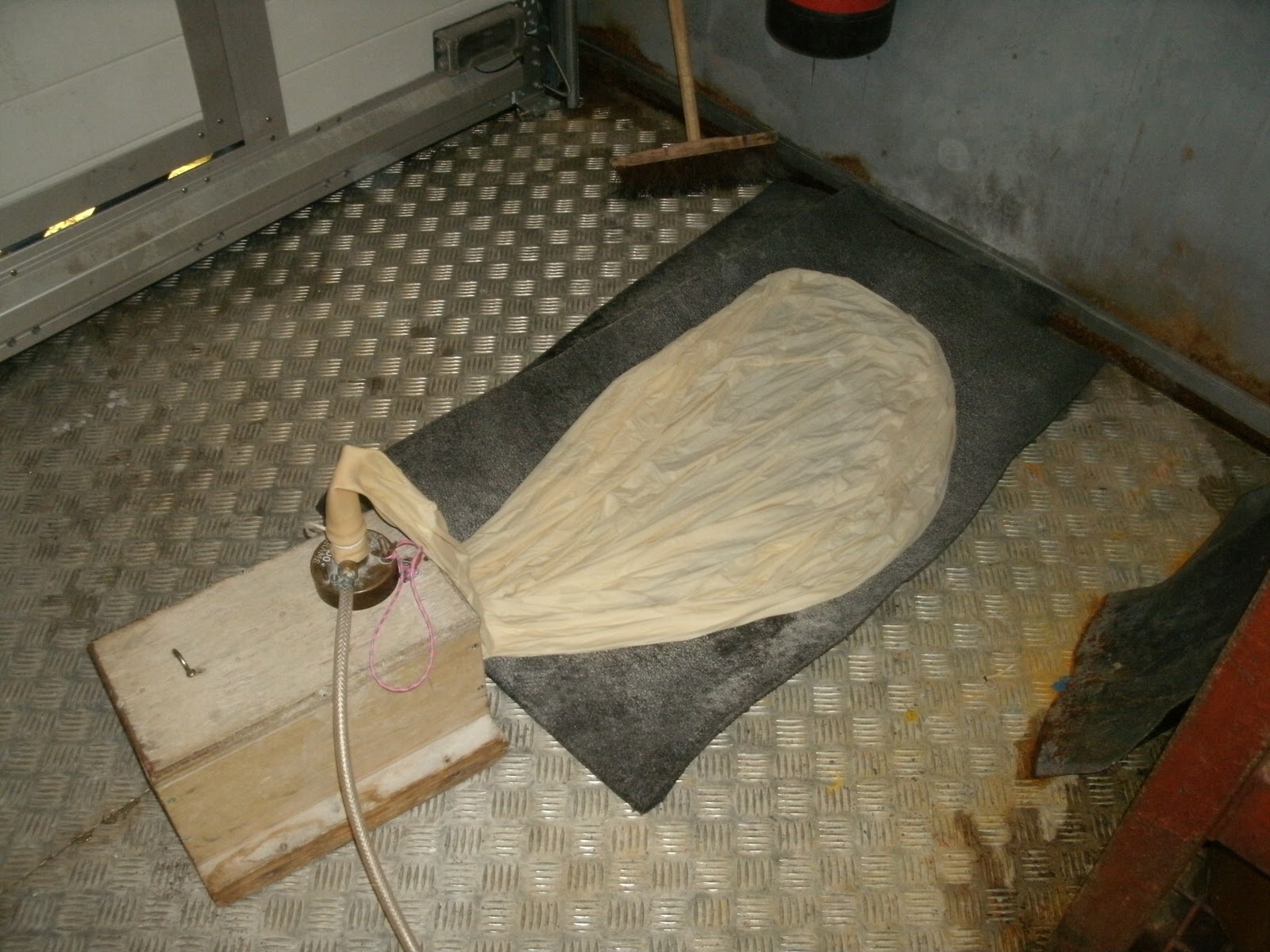
 We then walked over to a small caboose on stilts called BART, this is where the balloon is filled with Helium and prepared for flight. Here it is tied to a weight with string. The idea is to fill the balloon untill it lifts the weight off the board and the string is taught.

This is a pic of me actually filling the balloon with Helium.

 When full  it is 1 metre in diameter

 The weight is removed the kite string is attached and it is tied securely

 Then it is out onto the platform, holding the balloon securely in one hand and the transmitter loosely in the other open hand. It is time to release.

1.2.3...Let go... So if there is a problem with the weather today, It's my fault!

  And away it goes. Once released it rises high into the stratosphere expanding as it rises, it actually reaches a height of 28 km, expands to the size of a double decker bus and records temperatures of  -91.7 degrees celsius. It stays up there for approx 1.5 hours.


Then it was a walk across fresh snow left from the blow we had the previous day to the Laws building where i was going for my morning smoko of cheese and bacon on toast. En route i passed a Nanson sledge fully laden with emergency supplies all ready to be taken on a field trip. 

The Nanson Sledge, named after the explorer. These are the type of sledges that would have been pulled by the dogs. Now pulled by skidoos
Once inside the Laws building the screen on the wall shows The temperature, wind speed and pressure, updated constantly, thanks to the data from the weather balloon

With nothing else planned i was invited to accompany the doctor on a skidoo trip to the Skiway, where the pilots that have been staying with us were eventually setting off on a science trip to do some research. They had clear skies and good winds and had been on standby for a couple of days, waiting for a window in the weather. So i joined the send off party and went off on a jolly.

Approaching the Twin Otter plane riding on a sledge at the back of a skidoo.
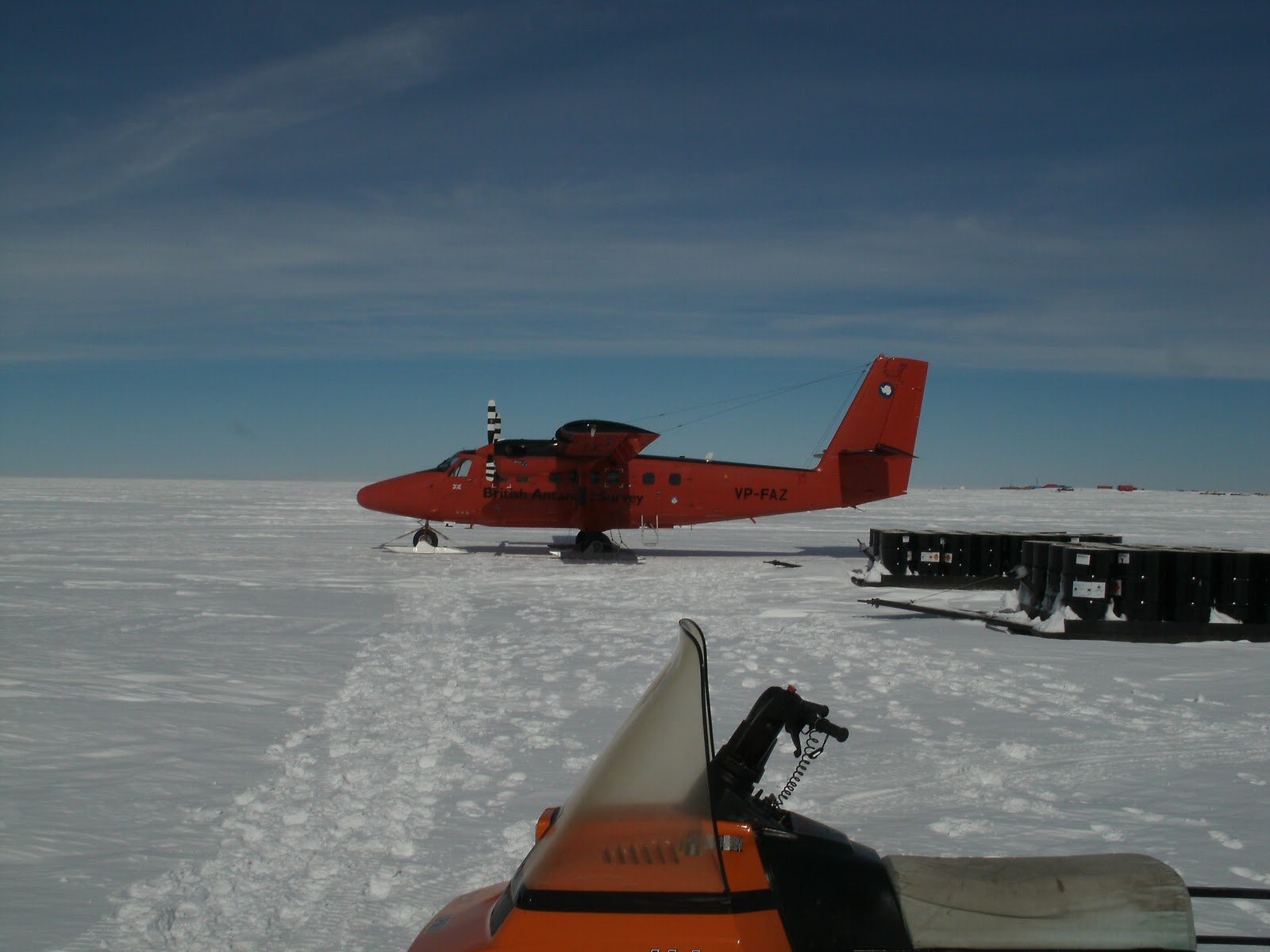
The Twin Otter with fuel drums to the right of the picture

These containers are placed on the Skiway to hold supplies and baggage

Sue, the other doctor turns up to see the plane leave

Michael and Susan the two Docs with the fire fighting sledge. they are attaching it to take it back.
 Every plane that comes in or leaves has to have a doctor and a fire sledge present.

Sledge attached to the skidoo ready to go.

Michael has a word with the pilot before take off

The runway has be groomed to firm it up for the plane to take off. James is the driving the Challenger which is pulling the Groomer

 Last call for the Halley flight. Me standing against the airport sign

 Groomer leaving the Skiway plane ready for take off.

 Richard, Michael, and James watch as the Twin Otter starts up.

There was another Halo around the sun.

Richard lying on the ground to get a shot of Michael in the Halo.

Plane gone and Rich gives me a lift back to the Laws for lunch


Monday, 6 December 2010

The New Modules

Sunday and one more plane to arrive carrying the last of the morrisons crew that are needed to get the new Halley VI Modules fitted geared up and hopefully in their new position before the end of summer. It is now all systems go and from tomorrow (monday 6th December) Everyone is full throttle. From my point of view, the chefs have been full throttle for the last week, ever since the last lot of Morrisons guys arrived. I have never known anyone who can eat like these guys. We now have a total of 95 eating 4 times a day. But we are cooking 150 portions of everything because some take 4 and even 5 main courses.. Today we went through 18 loaves of bread at brunch, until now it has only been 3 or 4 loaves a day.    So we in the kitchens are gearing ourselves up to be really busy once they all start working outside....Here are a few pictures of the new Modules, both blue and red...There are two blue accommodation modules, one blue observation module, one blue generator and supply module the rest are are science labs with the Big red one being the dining area, computer rooms, library and general entertainment module.


The Big Red Module Deep in snow and has to be moved


This Blue Module Has to be moved also

All the new Modules are fitted with Hydrolic legs and have skis attached. This is so they can be raised to stay on the surface and pulled other locations so as not to get snowed in and buried like Halley V.... Here the legs are being anchored together to stop everything from twisting during the move.
 
 All the snow is cleared using diggers to give access to the modules 
Here you can see the legs connected by the supports ready for the bulldozers to pull

The Morrisons crew get the chains attached and check everything is secure.

The Dozers are connected and they are given the order to pull. But they first pull each leg  gently sideways to free each leg from the ice

Blue Module ready for pulling out

All Blue Modules in place Just the big Red One to go

Ready for the work to commence


Sunday, 5 December 2010

A Day Out To The Coast

Thursday was my day off, so i volunteered for drum raising, which involved me doning my full polar gear, jumping on a sledge pulled by a converted John Deer tractor and heading off for the coast 15 kilometers away.
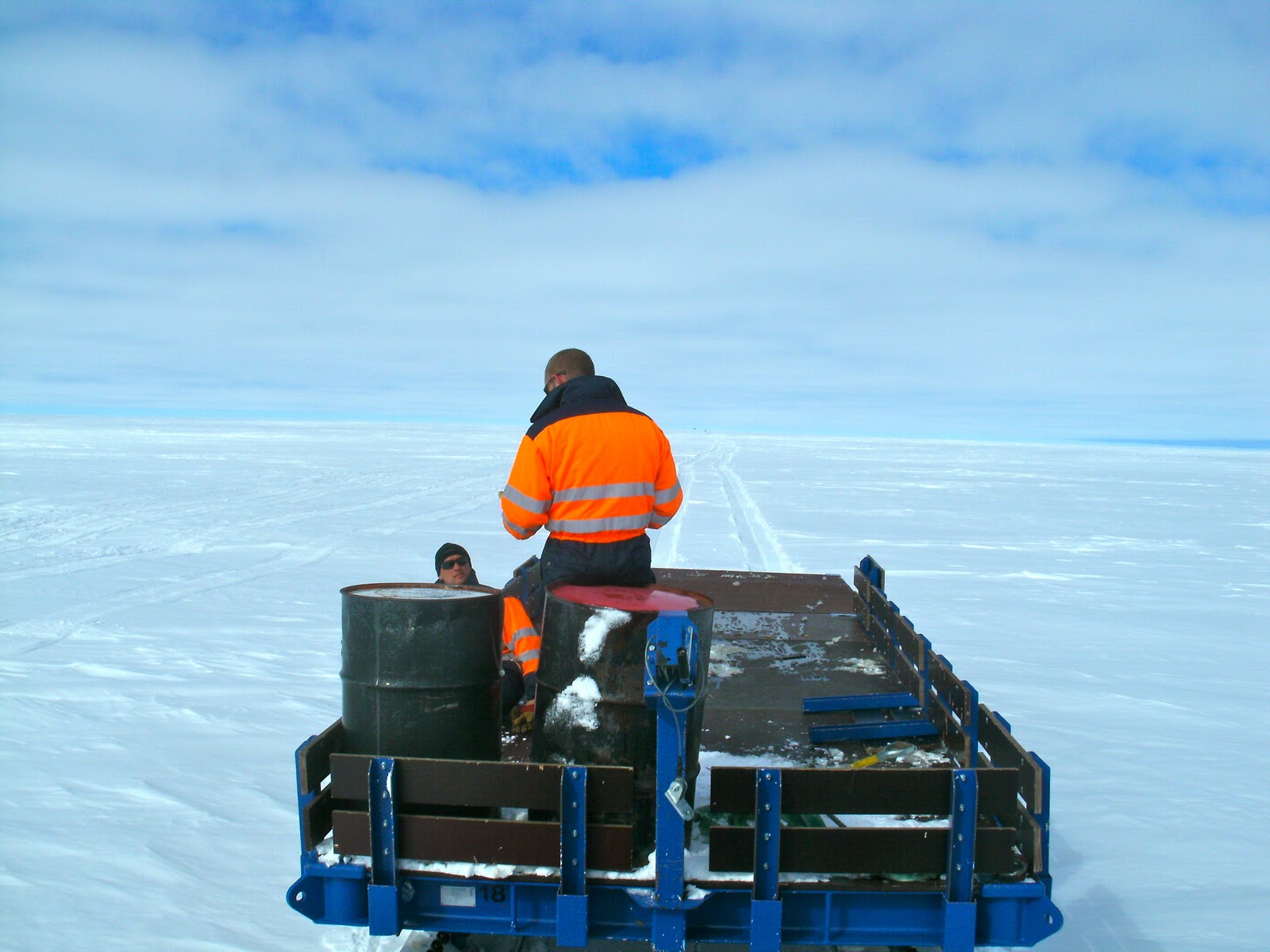
The job was to follow the line of oil drums all the way to the coast and dig them out of the ice as they had been buried. The drums are placed 250 meters apart and are there as a guide to find your way if the weather suddenly turns nasty. They mark the route to and from the sea ice where the Shackleton comes in. Once the drums had been dug out they were thrown onto the sledges ready to be replaced in thier new positions along the flag line that Kirk had set out yesterday.

The John Deer getting into position to attach the two sledges

Up and running, four drums dug up, only 48 more. on the top of the drivers cab are two sleeping systems, we had four all together. It is a safety requirement in case we had to dig in and bed down due to bad weather

 Matt, the base commander (standing) with Bryan sitting. Waiting for the next oil drum to dig out.
It is fantastic being pulled on a sledge in the middle of an ice desert, with nothing around.

Still waiting for the next drum

View from the back of the sledge with the Halley Camp just visible in the background.

View of the John Deer pulling the sledges, with the coast coming into view.

The next drum that needs digging out. The ice is more or less 1.5 miles thick below us.

The Coast line comes into view after nearly two hours. The colours and the sky change constantly

The oil Drums being loaded, my job was to stack them neatly on the sledge.

Bryan and Matt get digging. These drums if left will get buried within a season. Every year gets one to one and a half meters of compacted ice . So they are constantly drum raising.

Matt the base commander checking out the sea ice to see if it is stable enough to hold the Shackleton when it comes in with supplies.

The little red Hut on the left is a Caboose, that had to be pulled out of snow it was in. This is an emergency hut, that contains 4 beds and emergency sleeping systems, as well as food rations and equipment. It is an essential part of the operations on Antarctica and you find these Cabooses dotted at all the main routes where field trips and scientists venture.

Matt Directing James the driver into position ready to pull the Caboose free.

The sledges are unhitched for James to pull out the Caboose. Just look at the vastness of where i am standing.
It is awesome.
This is a picture of the sea ice..The rough bits you can see is called Brash, this at the moment is about 1 metre thick, the ship will have now problem cutting through this to tie up on the Ice shelf which is the white ice you can see, this is about 5 metres thick and is a year old. (last years Ice)

View of the coast line, within minutes the colours have changed yet again. the temperature is -8 with a wind speed of 3.7 which gives a subjective temperature of approx -12.

The cliffs of the coast line with a layer of pack ice, a layer of  brash, then open water. amazing!

From left to right, Bryan, Matt and James enjoying the solitude.

The same cliffs with a different sky.

A closer look at the Brash. and up close they are approx 7 feet high. It is actually pack ice that has been broken and pushed towards the shelf causing peaks.
Kirk, our GA field expert standing along side. Kirk goes in first to make sure underfoot is secure. If we decide to follow, we have to stay in his tracks. There are lots of crevasses that you could fall in.

Another view of the cliffs, from a different angle and again a different sky. I was a bit dissapointed that we did not see any penguins, but i did see their tracks. Kirk said he would take me on a one to one to see the penguins..So watch this space..

Back at the ranch and Pat and Chris are having a game of pool during their break.

The Laws building, showing the reason for the new build. The legs have been jacked up to their highest and can not go any more. Which means by next summer it will be buried. Hence tthe new modules of Halley VI
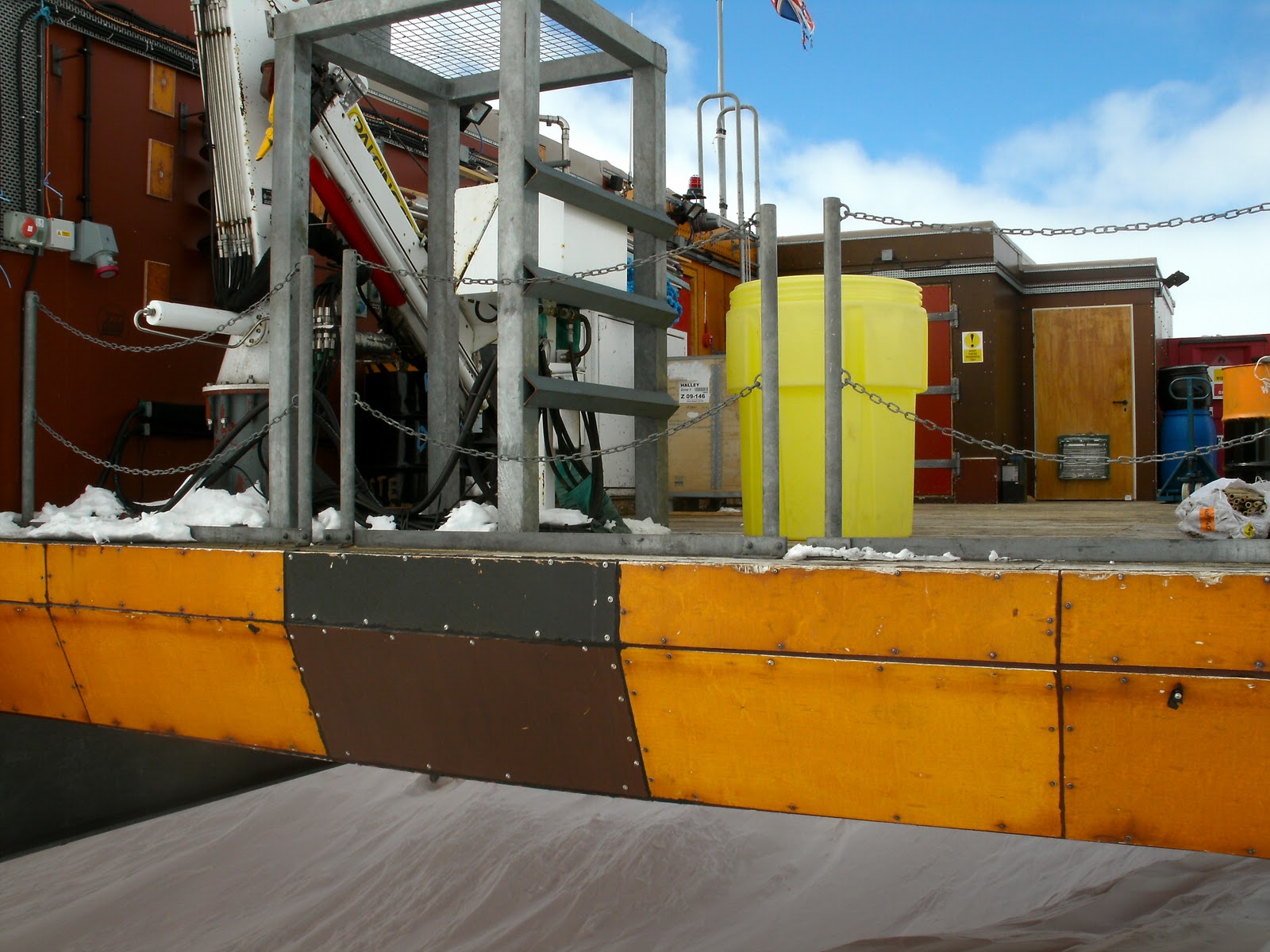
This is the Laws platform where we enter the building to work. The yellow drum in the picture, was filled with bread flour at the start of my employment 3 weeks ago. it is now empty.
Boy we go through some flour.....